How to Trim Your Wedding Guest List Without the Guilt: A 2025-2026 Guide
Learn expert strategies for trimming your wedding guest list. From the 1-year rule to the "Dinner Test," manage your budget and family expectations with ease.
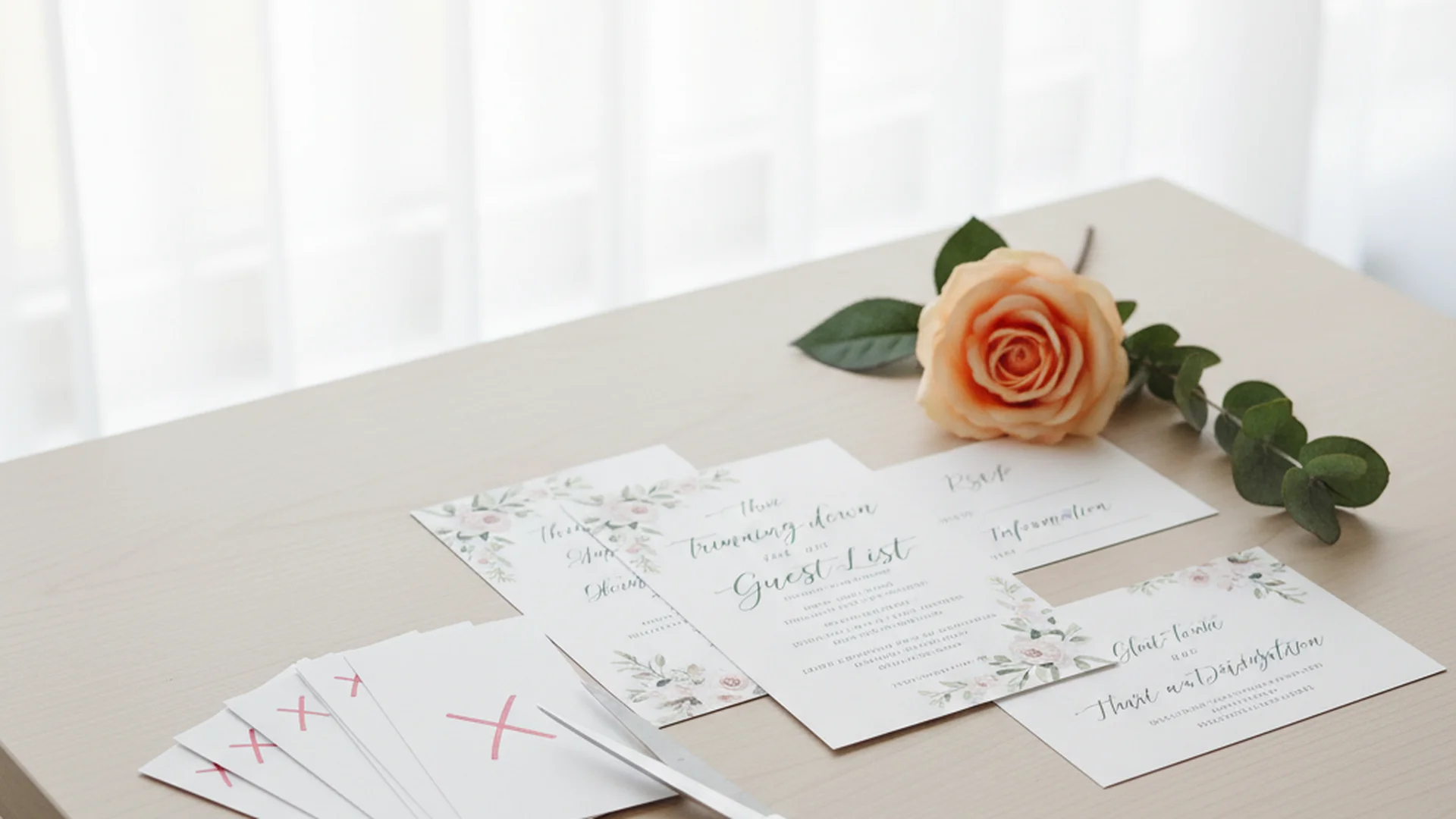
- Average cost per guest in 2025 is $284, making list trimming essential for budget control.
- Use the "1-Year Rule" and the "Dinner Test" to objectively evaluate every name.
- Establish hard boundaries on plus-ones and children before talking to family members.
Trimming your wedding guest list is often cited as one of the top five most stressful wedding planning tasks. As a relationship counselor, I see many couples struggle with the emotional weight of these decisions. It isn't just about a seat at a table; it's about navigating family expectations, social obligations, and the desire for an "intentional" celebration.
In 2025 and 2026, we are seeing a significant move away from the "invite everyone" mentality. Couples are opting for more curated, meaningful gatherings that prioritize the quality of the connection over the quantity of the crowd. Whether you are dealing with a strict venue capacity or trying to keep costs manageable in an inflationary market, trimming your list is a necessary—though challenging—step toward your dream day.
The Reality of Wedding Planning in 2025
Before we dive into the tactics of trimming, it is important to understand the landscape. Modern wedding planning is heavily influenced by rising costs and a shift toward digital efficiency.
In 2025, the average cost per guest has climbed to approximately $284. This includes catering, rentals, and favors, but does not account for fixed costs like photography or your venue fee. When you look at it through this lens, inviting 10 extra acquaintances isn't just "adding a few people"—it’s a nearly $3,000 decision.
Furthermore, a growing number of couples planning 2026 weddings are moving toward digital invitations or QR codes to manage their counts. This shift makes guest list management faster but also requires a solid final list earlier in the process.
| Metric | National Average (2025) | Destination Wedding |
|---|---|---|
| Guest Count | 116 - 145 | 45 - 75 |
| Attendance Rate | 75% - 85% | 50% - 60% |
| Average Cost Per Head | $284 | $350+ |
Note
Objective Rules for Trimming the List
When emotions run high, you need objective "hard rules" to fall back on. These rules act as a shield when you have to explain your decisions to parents or friends.
The 1-Year Rule
This is the gold standard for guest list management. If you haven't spoken to or seen a person in the last 12 months (outside of social media "likes"), they likely do not belong on the list. Relationships naturally ebb and flow; you are celebrating your current life, not your history from five years ago.
The "Dinner Test"
Ask yourself: "Would I feel comfortable taking this person out for a one-on-one $150 dinner?" If the answer is a hesitant "no," they shouldn't be at your wedding. This test helps put the financial investment into perspective.
The First-Name-Last-Name Rule
If you can’t remember someone’s last name (or they wouldn't know yours) without looking it up on social media, they are an acquaintance, not a guest. Your wedding should be filled with people who know your story, not people who just know your face.
Tip
The Tiered List Method
One of the most effective ways to manage the "trim" is to categorize your guests. This allows you to prioritize the people who matter most while creating a clear boundary for those who might have to be cut.
Tier 1: The Non-Negotiables
These are your "ride-or-die" friends and immediate family. If these people weren't there, the day wouldn't feel like your wedding. This tier is protected from any cuts.
Tier 2: The "B-List"
These are extended family members and friends you see occasionally. You would love to have them there, but if the venue capacity or budget became an issue, these are the names you would evaluate. For more on how to manage this, check out our guide on A List B List Wedding Guests.
Tier 3: The Obligatory Invites
This group includes coworkers, parents' friends, or distant acquaintances. Often, these people are added to the list out of guilt or perceived social pressure. In 2025, it is increasingly common—and acceptable—to cut this entire tier to save on costs.
Do this
Navigating Family and Financial Pressure
As a relationship counselor, I often see the guest list become a tug-of-war between the couple and their parents. This is especially true if parents are contributing financially.
The Financial Split
If your parents are paying, a traditional "fair" split is 50% of the guest list for the couple and 25% for each set of parents. However, in 2026, many couples are pushing for a 70/15/15 split to ensure the wedding feels like their party, regardless of who is writing the checks.
The "United Front" Strategy
You and your partner must agree on "hard rules" before talking to anyone else. Decide on your stance regarding children and plus-ones early. If you decide on an adults-only event, stick to it across the board to avoid accusations of favoritism. For help with the right terminology, see our post on Adults Only Wedding Wording.
Handling "Reciprocal" Invites
"But they invited us to their wedding three years ago!" This is a common refrain. Expert consensus for 2025 is clear: You are not obligated to invite someone just because they invited you. Relationships evolve, and your guest list should reflect your current life, not a social debt.
From the OurVows workspace
Wrangling the guest list?
Households, plus-ones, dietary needs, and RSVPs — all in one place, importable from a spreadsheet.
Modern Trends in Guest List Management (2025-2026)
The way we celebrate is changing. If you're struggling to trim the list, consider one of these emerging trends that naturally limits the headcount.
The "Intimate Grand" Wedding
Couples are keeping their guest list around 120 people but spending more on "micro-moments." Instead of a 250-person ballroom event, they choose a high-end restaurant or gallery and provide handwritten notes for every guest. This allows for a "grand" feel with an intimate count.
The Disappearing Wedding Party
A rising 2026 trend is forgoing bridesmaids and groomsmen entirely. This drastically simplifies the guest list because you are no longer obligated to invite the significant others and families of your wedding party members who were only invited by extension.
High-Low Catering Tactics
If you find you simply cannot cut more people, some couples are managing the "per head" cost by pairing high-end items (like a caviar station) with casual late-night favorites like sliders or fries. This keeps the "wow" factor high while managing the overall catering budget.
Heads up
Common Mistakes to Avoid
Even with the best intentions, it is easy to make a guest list blunder. Here are the three most common mistakes I see:
- Sending Save-the-Dates Too Early: Once a Save-the-Date is in the mail, you cannot un-invite that person. Wait until your Tier 1 and Tier 2 lists are 100% solid before mailing anything.
- Unclear Envelope Addressing: If children are not invited, do not write "The Smith Family." Be specific and write "Mr. and Mrs. Smith." Adding a line to your RSVP card like "We have reserved 2 seats in your honor" prevents "plus-one poaching."
- The Coworker Trap: You do not have to invite your boss or your cubicle-mate unless you socialize with them outside of office hours. A professional boundary is completely acceptable in 2025.
Note
Frequently asked questions
Do I have to invite plus-ones for my single friends?
Is it rude to have an "adults-only" wedding?
My parents are paying for the wedding. How many people do they get to invite?
What if I want a destination wedding to keep the list small?
How do I handle people who ask why they weren't invited?
Conclusion
Trimming your wedding guest list is a process that requires a balance of logic and empathy. By utilizing the 1-year rule, the dinner test, and a tiered list strategy, you can create a celebration that is both financially responsible and emotionally meaningful. Remember, your wedding is a celebration of your union, and the people surrounding you should be those who truly support and know you.
If you are just starting your planning journey and feel overwhelmed, take it one step at a time. The guest list is the foundation of your budget and your venue choice, so getting it right early on will save you countless headaches in the months to come.
Do this
Ready when you are
Ready to Start?
Organize your guest list with our professional tools today.
Ready when you are
Plan your wedding without the chaos.
Free forever for couples just getting started. Two minutes to set up. No credit card.
Keep reading

The Ultimate Guide to a Wedding RSVP Tracking System: 2025-2026 Edition
Master your guest list with an automated Wedding RSVP Tracking System. Learn about AI tools, QR codes, and expert tips for managing your 2025 wedding.

The Ultimate Guide to Managing A List B List Wedding Guests
Learn how to effectively manage A List and B List wedding guests. Maximize your venue capacity and budget without social awkwardness or etiquette mistakes.

Mastering Wedding Welcome Bags for Guests: The Ultimate 2025 Guide
Learn how to create memorable wedding welcome bags for guests. Explore 2025 trends, budget breakdowns, and expert tips to enhance your guest experience.